
artist/ Andrzej Fogtt
Pologne

Painting as Energy and Memory
In Andrzej Fogtt’s work, painting is above all an experience of energy. Colour, line and rhythm do more than describe the world: they reveal its invisible forces. Moving between figuration and abstraction, the Polish artist has spent several decades developing a distinctive language in which nature, memory and human presence become elements of a shared pictorial exploration.
Born in Poznań in 1950, Andrzej Fogtt lives and works in Warsaw. He graduated in 1974 from the State Higher School of Fine Arts in Poznań, where he studied under Zdzisław Kępiński and Magdalena Abakanowicz, and established himself as a prominent figure in contemporary Polish painting. His training encouraged considerable freedom of experimentation, nourished by the dialogue between painting, drawing, sculpture and textile art.
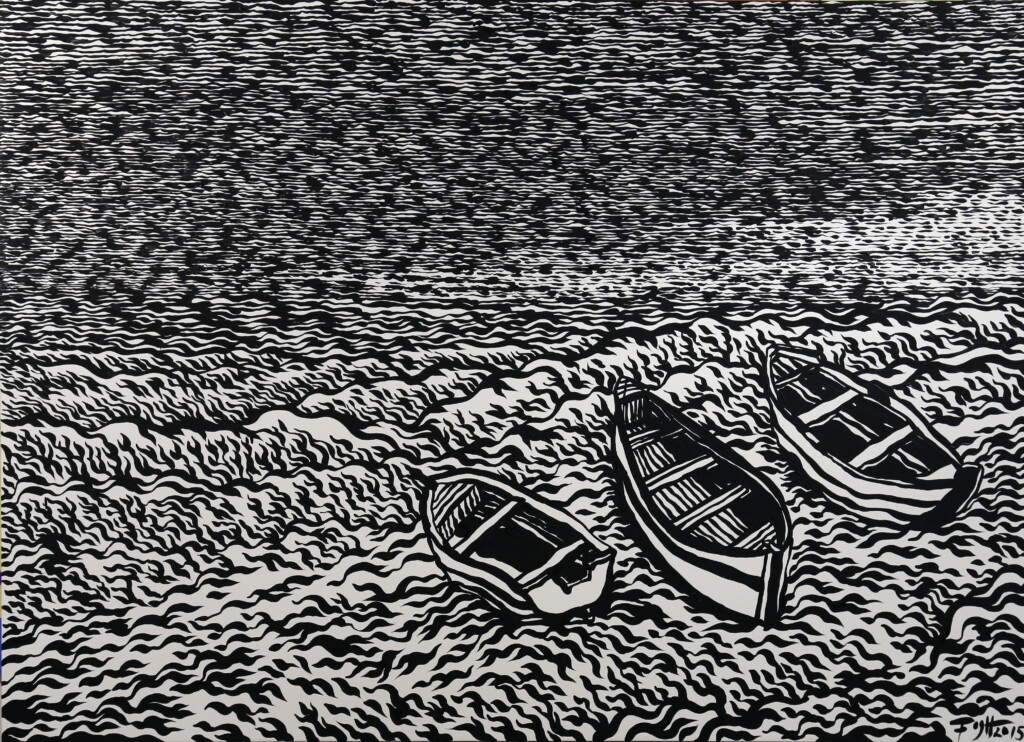
Initially associated with New Figuration, his work gradually moved beyond stylistic categories. Fogtt developed an immediately recognisable pictorial language: closely spaced lines, dots and touches of colour accumulate and vibrate, seeming to generate space from within. The chromatic intensity of some canvases finds its counterpart in other, almost austere works, which set the depth of black against the luminosity of white. This diversity represents the expression of a consistent search for tension and balance.
Nature remains a constant source of inspiration. In his series devoted to the elements, rivers and landscapes, it appears as a living force in perpetual transformation. The series Żywioły (The Elements), Żywiołem opętanie (Possessed by the Elements), Genesis and Obrazy Sferyczne (Spherical Paintings) reflect his exploration of movement, light, vibration and infinity. The landscapes of the Brda and Bug rivers thus become the basis for a meditation on time and the continuity of life.
The human figure also holds an essential place in his work. Fogtt regularly returns to portraiture and the presence of the body, approaching them less as a matter of likeness than as a space in which emotion, memory and relationships with others are inscribed. In his compositions, a face may emerge from a dense network of marks or be reduced to a few traces, as though identity were taking shape at the boundary between the visible and the invisible.
In 1984, the artist represented Poland at the 41st Venice Biennale, notably through Misterium czasu (The Mystery of Time), an environment created with sculptor Bożenna Biskupska. That same year, he received the Grand Prix at the Festival of Contemporary Polish Painting in Szczecin. His work subsequently appeared in numerous exhibitions in Poland and abroad, including Berlin, London, Paris, Moscow, Arras, Lille, Florence, Hamburg and Brussels. In 2009, he was awarded the Gloria Artis Medal by the Polish Ministry of Culture and National Heritage.
His imagination extends beyond the canvas. He also develops projects with architectural and symbolic dimensions, including the Tower of European Unity, conceived as an expression of human solidarity. This movement between painting and space reflects a deeply held conviction: art can give tangible form to a sense of community while preserving the uniqueness of each individual experience.
Since 2007, Andrzej Fogtt has collaborated with DAGART Galerie, which supports the presentation of his work in France and at international contemporary art fairs. This longstanding dialogue reflects the gallery’s mission to bring Polish and Western European perspectives into exchange. According to information provided by the gallery, works by the artist have notably entered the collections of the Musée d’Arras.
Before a painting by Fogtt, the eye never settles on a definitive form. It moves through pictorial matter in motion, searches for points of reference, then yields to a broader rhythm. In this painting, where every mark seems charged with energy, representation becomes sensation, and landscape becomes a memory of the world.